
Aerobatic Maneuvers Explained: Loops, Rolls and What You’re Watching
The plane pulls vertical, smoke pouring off the wingtips, then pivots on its tail and drops back toward the runway. What did you just see? Here’s how to name every move in the sky over Abbotsford.
Look up during any performance at the Abbotsford International Airshow and you’ll see an aircraft do things that feel impossible. It climbs straight up, hangs for a heartbeat, then tumbles, rolls and recovers as if gravity took the afternoon off. Most people in the crowd cheer without quite knowing what they watched. This guide fixes that. By the time you finish reading, you’ll be able to call out a hammerhead before the announcer does and explain to the person beside you exactly what makes it hard.
We’ll clear up one bit of confusion first, then walk through the signature maneuvers one by one, each with a quick “what to look for” so you can spot it from the flight line.
Aerobatics vs. acrobatics: clearing up the confusion
People search both words, and they often mean the same thing in casual conversation. There is a real distinction worth knowing. Acrobatics is the broad term for gymnastic feats of balance and agility, the kind you’d see from a gymnast on a mat or a performer in a circus tent. Aerobatics is that same idea taken into the air. The word is a blend of “aerial” and “acrobatics,” and it describes flying an aircraft through deliberate maneuvers that have nothing to do with getting from point A to point B.
AEROBATICS, DEFINED
Aerobatics is the practice of flying an aircraft through intentional maneuvers like loops, rolls, spins, stall turns and tumbles that aren’t part of normal flight. It’s flown for sport, training and the kind of performance you’ll watch at an airshow.
So which word is correct for the airshow? Aerobatics. Pilots, judges and competition organizers all use it. If you call a barrel roll “acrobatics” nobody will correct you at the picnic table, but now you know the difference.
What makes an aerobatic airplane different
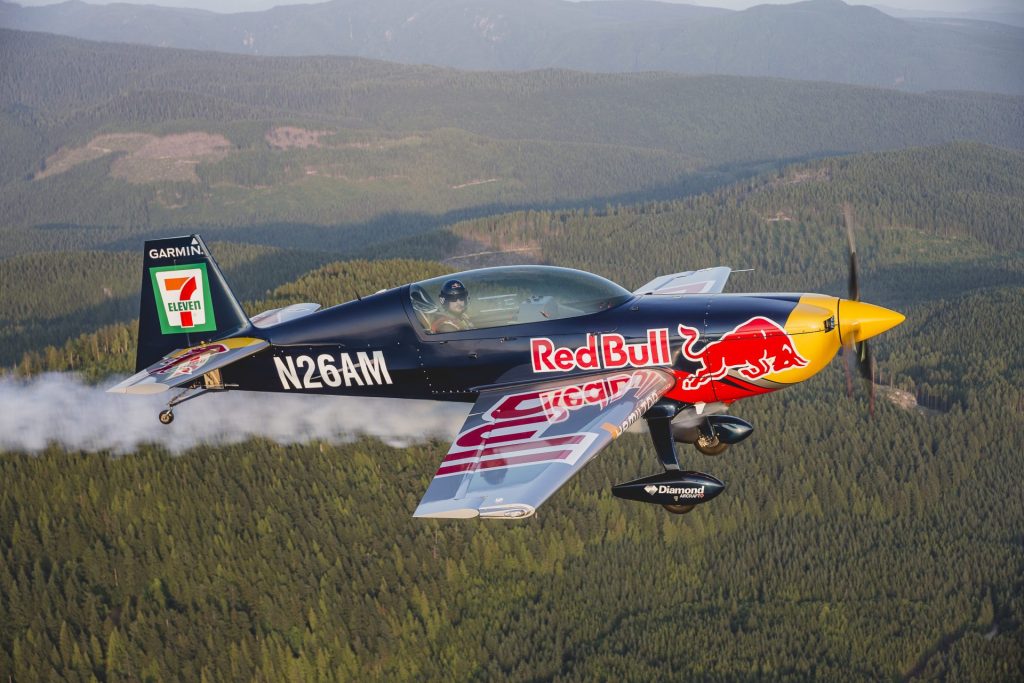
You can’t fly these routines in just any aircraft. An aerobatic airplane is built for stress that would tear an ordinary plane apart. The airframe is stressed for high G-loads in both directions, the wing is often symmetrical so it flies as well upside down as right side up, and the control surfaces are oversized for a fast, crisp response. Add a high power-to-weight ratio and you get a machine that can point its nose almost anywhere and hold it there.
The names you’ll hear over the public-address system tell the story. Civilian solo acts tend to fly the Extra 300 series, the nimble little Pitts Special biplane, or the Sukhoi Su-26, all of them light and absurdly responsive. Jet demonstrations bring a completely different feel, with raw thrust standing in for that piston agility. Honestly, the first time you see an unlimited-class monoplane snap from level flight into a vertical climb without seeming to slow down, the engineering becomes the most impressive part of the whole act.
The signature advanced aerobatic maneuvers, and what to look for
Here’s the heart of it. These are the moves you’ll see most often, roughly from simplest to showiest. Read the “what to look for” line for each, then watch the smoke trails during the show. The smoke is your cheat sheet, because it draws the shape of the maneuver in the sky and hangs there for a few seconds after.
1 – The loop
The loop is the move everyone pictures first. The pilot pulls the nose up and over in a vertical circle, flying a complete 360-degree ring before leveling out at roughly the same spot they started. It sounds simple, and it’s the foundation for almost everything else, but a clean loop is genuinely hard. A round one means the pilot managed engine power, airspeed and back-pressure perfectly all the way around.
What to look for: a smoke trail that forms a true circle, not an egg. Judges and pilots obsess over how round it is.
2 – The aileron roll and barrel roll
These two get mixed up constantly, so watch closely. In an aileron roll the aircraft spins around its own length like a rotisserie, nose pointed straight ahead the whole time. A barrel roll is bigger and more graceful: the plane corkscrews through the air as if tracing a path around the outside of an invisible barrel, climbing and turning at once. The barrel roll is gentler on the pilot, the aileron roll is snappier to watch.
What to look for: if the nose holds a straight line, it’s an aileron roll. If the plane carves a wide spiral and drifts off to the side, it’s a barrel roll.
3 – The hammerhead (stall turn)
This one always gets gasps. The pilot pulls vertical and climbs straight up until the aircraft nearly runs out of airspeed. Just before it stops, a boot of rudder pivots the nose around like a hammer swinging over, and the plane points straight back down and dives. For a split second at the top, the aircraft seems to hang motionless in the air.
What to look for: the pause at the very top. A great hammerhead pivots on a fixed point with almost no sideways slide.
4 – The Cuban eight
Picture a figure eight lying on its side, drawn in smoke. The pilot flies up and over the top of a loop, rolls upright while descending along a 45-degree line, then repeats the shape in the opposite direction to complete the eight. It’s a combination maneuver, which means it strings several skills into one flowing sequence, and a well-flown one looks effortless even though it isn’t.
What to look for: two interlocking loops forming a sideways “8,” with a crisp half-roll on each descending diagonal.
5 – The Immelmann turn
Named after a First World War fighter pilot, the Immelmann is a half loop followed by a half roll. The aircraft climbs up and over into inverted flight at the top, then rolls upright. The payoff is that the plane finishes higher than it started and pointed in the opposite direction, which is why it began life as a combat move to gain altitude while reversing course.
What to look for: the plane goes up, flips direction, and ends up noticeably higher than where it began.
6 – The knife-edge pass
One of the most photogenic moves on the card. The pilot rolls the aircraft 90 degrees so the wings point straight up and down, then flies a long, level pass on the fuselage alone. With no wing surface holding it up, the lift comes from the side of the body and a lot of rudder, so it’s a real balancing act at speed.
What to look for: the belly of the aircraft facing you as it streaks down the show line, wings vertical the entire pass.
7 – The tail slide and tumbling figures
This is where unlimited-class pilots show off. In a tail slide the aircraft climbs vertically until it stops and actually slides backward for a moment before the nose falls through. Tumbling figures like the Lomcevak send the plane pitching end over end, looking for all the world like it’s falling apart, before the pilot catches it and flies away clean. These maneuvers put the most unusual loads on the airframe and the pilot, and they’re the ones that make a crowd go quiet.
What to look for: a brief backward slide, or a violent end-over-end tumble that suddenly resolves into smooth, controlled flight.
8 – Formation maneuvers and opposing passes
Solo acts show precision, but formation teams like the Canadian Forces Snowbirds show trust. Several aircraft fly maneuvers in tight formation, sometimes just feet apart, then break into a “bomb burst” where they fan out in every direction at once. Opposing passes, where two aircraft race toward each other and cross at the show’s center point, are choreographed to the second.
What to look for: the moment of the crossover or the bomb burst, and how perfectly the smoke trails stay spaced as the team moves.
How to watch like a pro at Abbotsford
Now that you can name the maneuvers, a few habits will make the whole show read more clearly from the ground.
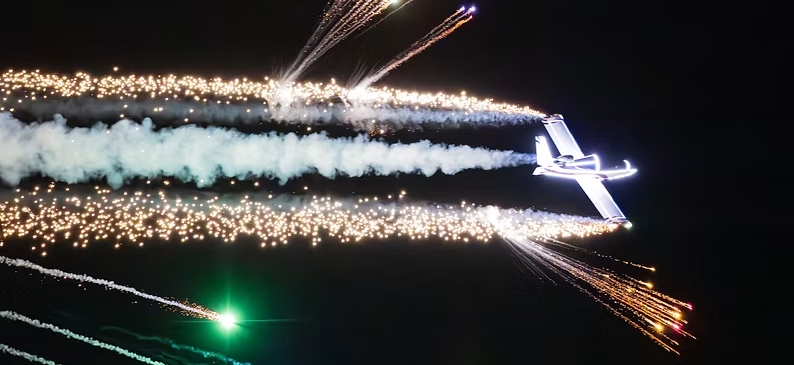
- Watch the smoke, not just the plane. The trail draws the maneuver’s shape and lingers, so you can judge how round a loop was or how clean a roll stayed.
- Listen to the announcer. The public-address team calls maneuvers in real time and explains what makes each one difficult, which is the fastest way to learn the vocabulary.
- Pick one aircraft in a formation and follow only it. You’ll appreciate the spacing far more than if you try to track the whole group at once.
- Notice the recovery, not just the trick. The skill is often in how smoothly the pilot exits a tumble or catches a slide, not the dramatic part in the middle.
- Get there early for the solo acts. They tend to show the widest range of rolling and tumbling figures, so it’s the best window for spotting everything on this list.
One more thing worth saying: every routine you watch was approved, rehearsed and flown inside strict safety limits set well above the crowd. The drama is real, but so is the discipline behind it. That mix of precision and showmanship is exactly what brings people back to the flight line year after year.
Want to know who’s flying these routines? Our Ultimate Guide to Airshow Pilots introduces the people behind the smoke, and you can see this year’s lineup on the performers page.
FAQ
What is the difference between aerobatics and acrobatics?
Aerobatics is the practice of flying an aircraft through deliberate maneuvers like loops, rolls and spins that aren’t part of normal flight. Acrobatics is the broader word for gymnastic feats on the ground, the kind a circus performer or gymnast does. Aerobatics is simply aerial acrobatics, so when you watch planes carve shapes in the sky at Abbotsford, the right term is aerobatics.
Both words get searched and used interchangeably in everyday speech, which is why the confusion sticks around. Among pilots, judges and competition organizers, though, it’s always aerobatics. Knowing the difference is a small thing that makes you sound like a regular on the flight line.
What is the most difficult aerobatic maneuver?
Most aerobatic pilots point to tumbling maneuvers like the Lomcevak, where the aircraft pitches and rotates end over end while seeming to fall out of control. It demands precise timing, plenty of power and an airframe built to take unusual loads, then a clean catch to fly away smoothly.
The tail slide is another strong contender, because the aircraft briefly flies backward before the nose drops, which puts stress on the controls in a direction they don’t normally see. Difficulty is partly in the eye of the beholder, but anything that mixes precision with a moment of apparent chaos tends to top pilots’ lists.
How many Gs do aerobatic pilots pull?
Competition and airshow pilots routinely pull between 6 and 10 positive Gs, plus several negative Gs, across a single routine. At 9 Gs, a 180-pound pilot effectively weighs more than 1,600 pounds pressed into the seat, which is why pilots train hard to keep blood flowing to the brain.
Purpose-built aerobatic airplanes such as the Extra 330 are stressed for these loads with a healthy safety margin, so the aircraft is rarely the limiting factor. The human body usually is, which is part of why each routine is choreographed so the hardest loads don’t last long.
What kind of planes perform aerobatics at airshows?
Civilian solo acts usually fly light, high-powered piston aircraft such as the Extra 300 series, the Pitts Special biplane or the Sukhoi Su-26. Each is chosen for a strong airframe, a fast roll rate and a high power-to-weight ratio that lets the pilot point the nose almost anywhere.
Military demonstrations bring jets like the F-16 or the CF-18 Hornet, and formation teams such as the Canadian Forces Snowbirds fly the CT-114 Tutor. The flying styles differ a lot: pistons favor tight rolling and tumbling figures, while jets lean on speed, energy and tight formation work.
How do aerobatic pilots not pass out?
Pilots use a straining technique that tightens the legs and core to keep blood from pooling away from the brain during high-G pulls. Conditioning, experience and keeping each high-load moment short all help, and routines are designed so the toughest forces never last more than a few seconds.
Negative G, where blood is pushed toward the head during inverted maneuvers, is a different challenge and is managed mostly through training and by limiting how long the pilot stays under that kind of load. It’s a physical sport as much as a flying one.
Which aerobatic maneuvers will I see at the Abbotsford International Airshow?
Expect loops, barrel and aileron rolls, hammerheads, Cuban eights, knife-edge passes and formation crossovers across the weekend, depending on the year’s lineup. Solo civilian acts tend to show the full vocabulary of rolling and tumbling figures, while jet teams favor high-speed passes and tight formation work.
The day’s program and the public-address announcer will call out many maneuvers as they happen, so keep the printed schedule handy. Use the glossary above as your guide and you’ll recognize most of what flies over the crowd.
See these maneuvers live
Reading about a hammerhead is one thing. Feeling the engine note change as the smoke pours off the wingtips is another. Join us on the flight line at the Abbotsford International Airshow.