1960s

The Abbotsford Airshow began in 1962 when the Abbotsford Flying Club held an airshow to promote flying from the Abbotsford Airport. The Flying Club partnered with the Abbotsford Rotary Club who provided $700 to fund the event. The first show was a success, attracting 15,000 people. By 1965 the Abbotsford Airshow had become the largest airshow in Canada.

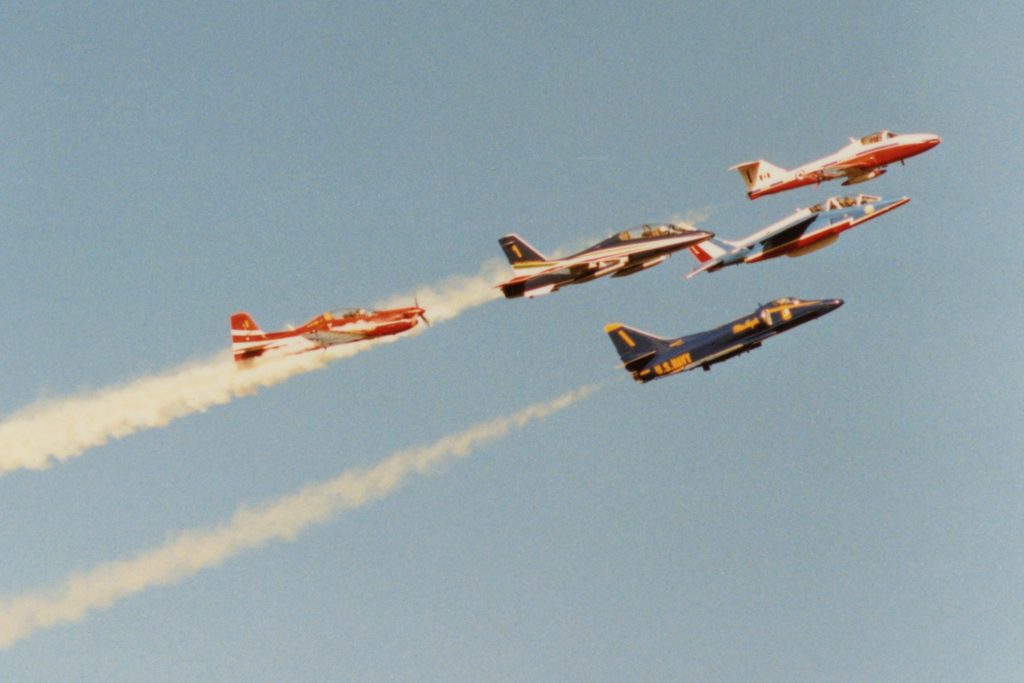
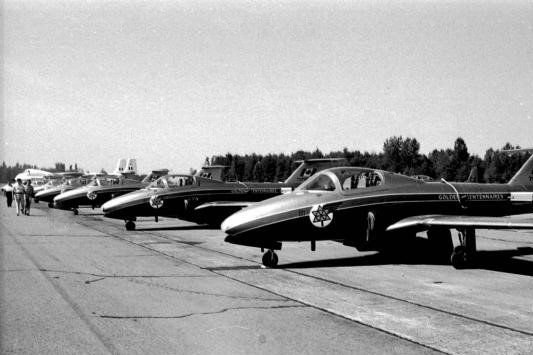
In 1967, the Abbotsford Airshow was included as an official Canadian Centennial project and featured the RCAF Golden Centennaires and the US Navy Blue Angels, along with a broad range of aircraft from Canada, the United States and Britain’s Royal Air Force. Upon conclusion of the 1967 show, the ad hoc Centennial Air Show Society re-formed permanently as the Abbotsford International Air Show Society.
1970s

In 1970, Prime Minister Pierre Elliott Trudeau officially recognized the Abbotsford Airshow as “Canada’s National Airshow”. A cairn commemorating this designation stands outside the Abbotsford International Airport terminal containing rocks from all over the world – among them are cobblestone from Paris, granite from the original London Bridge and stone from the Matterhorn.

The Snowbirds officially debuted at Abbotsford in 1971. The iconic Canadian team has not missed an Abbotsford show since.

In 1974, King Hussein bin Talal of Jordan attended the Abbotsford Airshow and upon returning home ordered the formation of a national aerobatic team. The Royal Jordanian Falcons were formed in 1976 and performed the following year at Abbotsford.

The Abbotsford International Airshow was officially recognized as a United States Bi-Centennial event in 1976, even though it took place in Canada. The US Navy Blue Angels and US Army Golden Knights joined the Snowbirds to commemorate the event.

1980s

The 1980 Abbotsford International Airshow was significant as it was the site of the first appearance in Canada of the new F/A-18 Hornet; Canada’s new front line fighter jet. The Hornet would return flying for the first time in Canadian colours in 1983 and has been an annual attendee ever since.

The 1980s saw a significant rise in international participation at Abbotsford. The United States Air Force and Navy and Britain’s Royal Air Force were annual attendees. The Royal New Zealand Navy appeared in 1984 followed by the Brazilian Air Force display team, Esquadrilha da Fumaca (Smoke Squadron) in 1985.

The 1986 Abbotsford International Airshow was held in conjunction with Expo ‘86 in Vancouver and featured five military demonstration teams: the Patrouille de France, Italy’s Frecce Tricolori, the US Navy Blue Angels, Brazil’s Esquadrilha da Fumaca, and Canada’s Snowbirds. The USSR also made its North American debut with an Antonov An-124 and An-74. The SR-71 Blackbird was also on static display at the airshow – the first (and perhaps only) time the Blackbird has ever been on Canadian soil for public display.

The 1986 Airshow attracted crowds of over 300,000 spectators over the three days. Building on the success and international participation of Expo ’86, the Abbotsford Airshow founded Airshow Canada in 1989, an international aerospace trade show to be held in conjunction with the show.

The USSR was again strongly represented in 1989 with aircraft including two MiG-29 Fulcrums and the An-225 Mriya, the world’s largest aircraft. History was made at the show when Major Bob Wade, a CF-18 Hornet pilot, became the first western pilot to fly a modern fighter jet from the USSR. Major Wade took the controls of the Mig-29 along with Soviet test pilot Valery Menitsky. Attendance at the 1989 show reached a record 321,000 people.

1990s

In preparation for the 1991 Airshow Canada event, the 120,000 square foot Tradex building was commissioned and built in just 100 days. Airshow Canada attracted 500 exhibitors from more than 50 countries and ran annually in Abbotsford until 1997. The combined profile of the Abbotsford International Airshow and Airshow Canada saw unprecedented international participation highlighted by rare appearances of Soviet aircraft and secretive American stealth aircraft.

Present in 1991 were two Su-27 Flankers, two Il-76 Candids, a MiG-31 Foxhound, Ka-32 Helix, and Su-26 and Yak-55 aerobatic aircraft. Following the break-up of the Soviet Union in 1992, the Ukrainian Air Force sent two MiG-29s on a North American tour including a stop in Abbotsford. Russia’s national formation team – the Russian Knights – appeared in 1993 flying six Su-27 Flankers.

The USAF F-117 Nighthawk Stealth Fighter made its first landing in Canada at Abbotsford in 1991 and was displayed under very strict security. In 1997, Abbotsford was treated to a rare display of the landing of a U-2 Spyplane complete with chase car. The U-2 was on static display the rest of the weekend. A B-2 stealth bomber also made its first Abbotsford visit with a fly-by on Saturday.

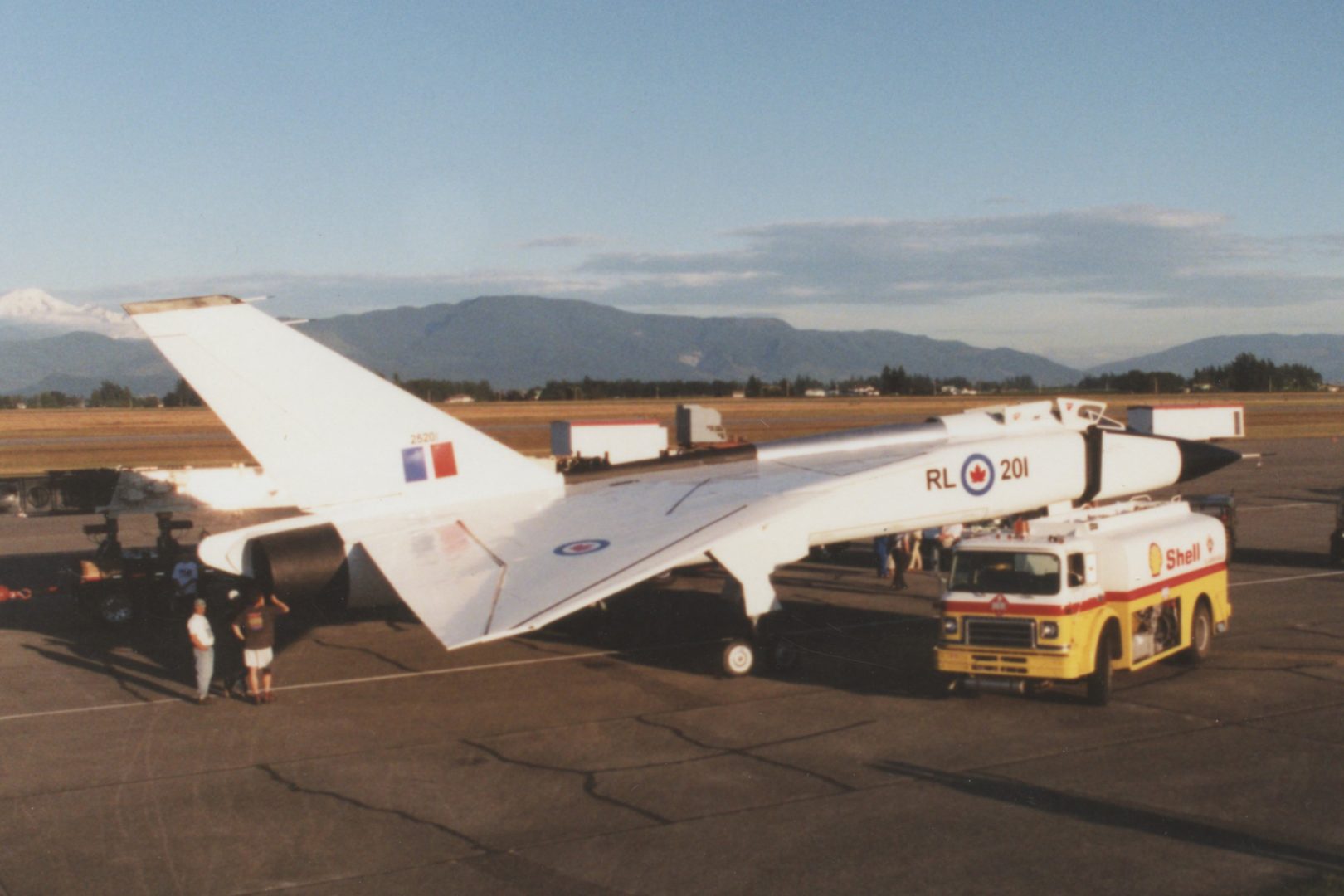
Another highlight in 1997 was a full scale replica of the Avro Arrow on static display. The Arrow replica was built in large part at the Abbotsford Airport by a group of airshow volunteers for the CBC mini-series “The Arrow”.

Unfortunately, 1998 marked the only year Abbotsford did not hold an airshow since its inception in 1962 due to financial problems. The Airshow was able to raise the necessary capital to return in 1999 and has not missed a year since.

Unfortunately, 1998 marked the only year Abbotsford did not hold an airshow since its inception in 1962 due to financial problems. The Airshow was able to raise the necessary capital to return in 1999 and has not missed a year since.

2000s

2002 marked the 40th anniversary of the Abbotsford International Airshow – a milestone accomplishment in the wake of 9/11 and rising insurance costs threatening the air show industry. The USAF Thunderbirds returned for the first time since 1993 to co-headline the event with the Snowbirds.

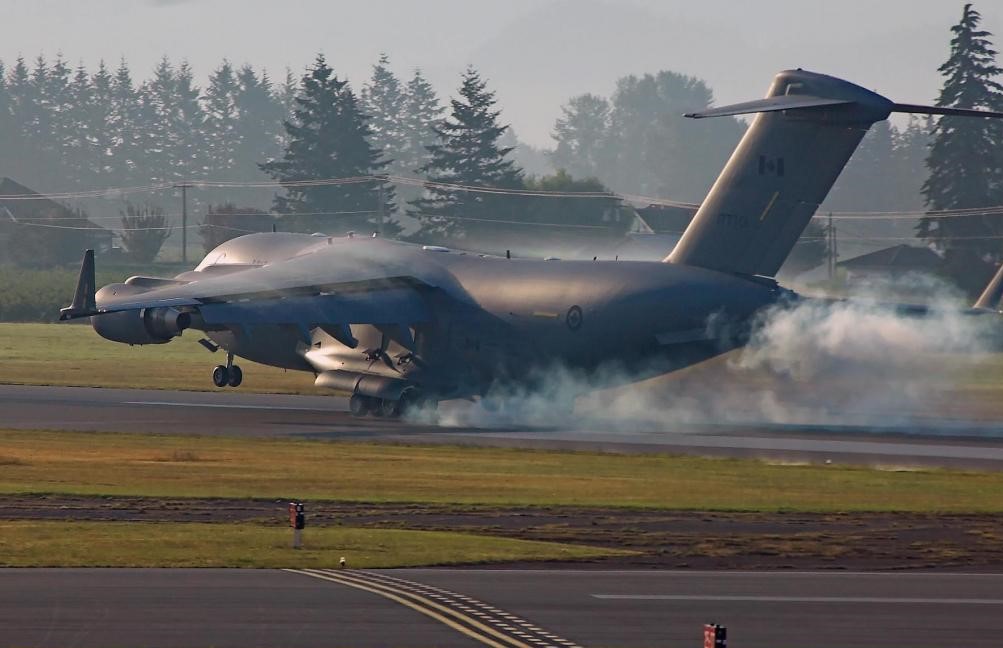
The first CC-177 Globemaster was delivered to the Canadian Armed Forces at Abbotsford in 2006. The aircraft arrived on Saturday morning and was on display for a few hours before departing to Trenton, ON.

The 2009 Abbotsford Airshow helped celebrate 100 years of flight in Canada, including a Centennial Heritage Flight with a CF-18, CT-114 Tutor, and F-86 Sabre painted in Golden Hawks colours. The F-86 Sabre “Hawk One” would be flown by Canadian astronaut and future ISS Commander, Chris Hadfield.

2010s

The Abbotsford International Airshow celebrated its 50th anniversary in 2012. As they did a decade earlier, the USAF Thunderbirds appeared alongside the Snowbirds as headline performers to commemorate the occasion.

In 2014, USA Today named Abbotsford as one of the “Ten Best Air Shows in the World.” That same year, the International Council of Air Shows recognized Abbotsford as one of the best civilian air shows in North America with a Pinnacle Award. The Friday Twilight Show was also added to Abbotsford in 2014 to great success.

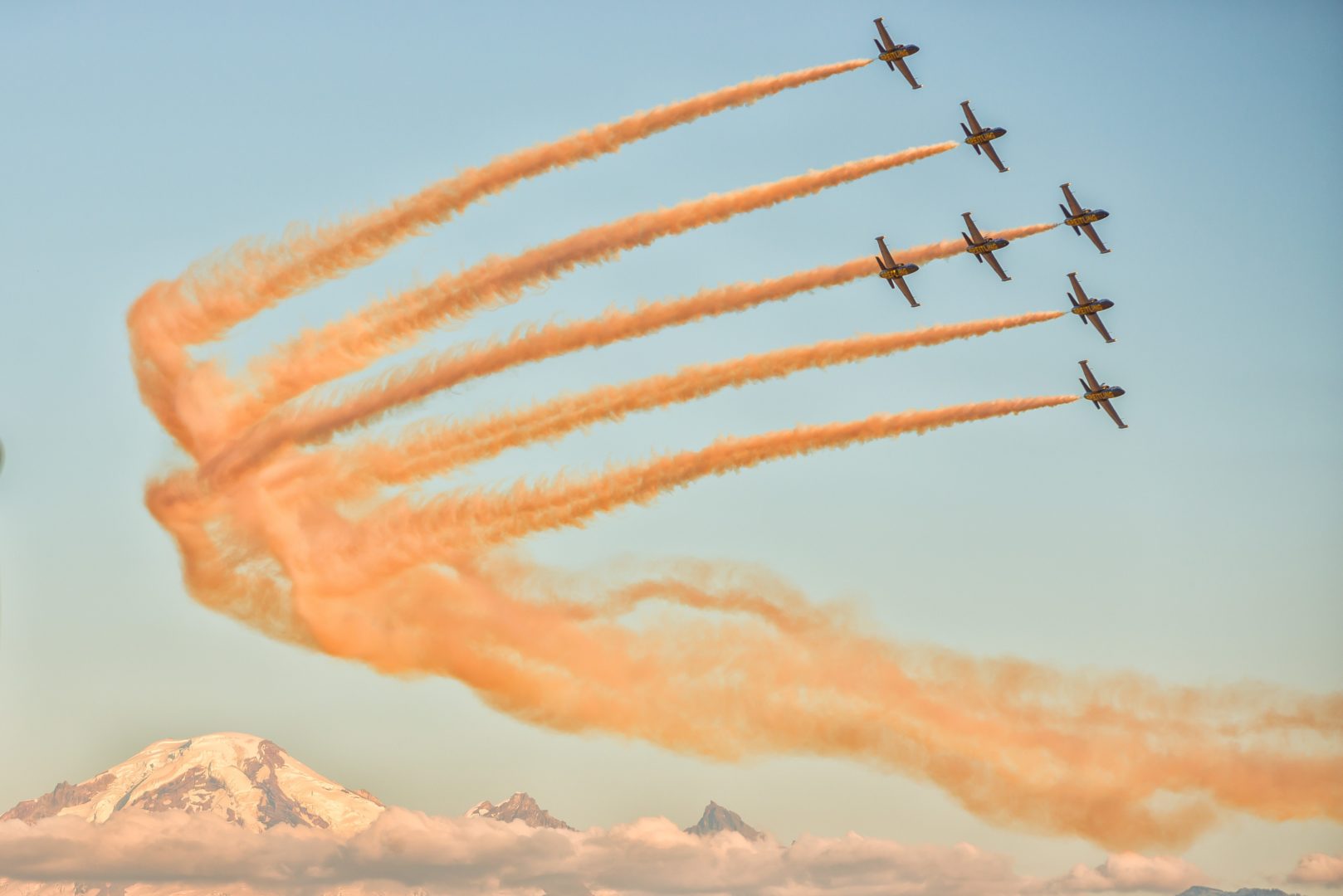
The Breitling Jet Team from France made its first Canadian appearance at Abbotsford in 2015 as part of their North American tour. The team would return for a second appearance at the 2016 show before returning to Europe.

In 2016, the F-35 Lightning II – a candidate to replace the CF-18 Hornet – made its first-ever appearance in Canada on static display at the Abbotsford Airshow. Also notable was another potential replacement candidate – the F/A-18 Super Hornet – which performed a tactical demonstration at the 2016 show. Both aircraft would return and fly in the 2017 Abbotsford Airshow to help celebrate Canada’s Sesquicentennial (150th) anniversary.

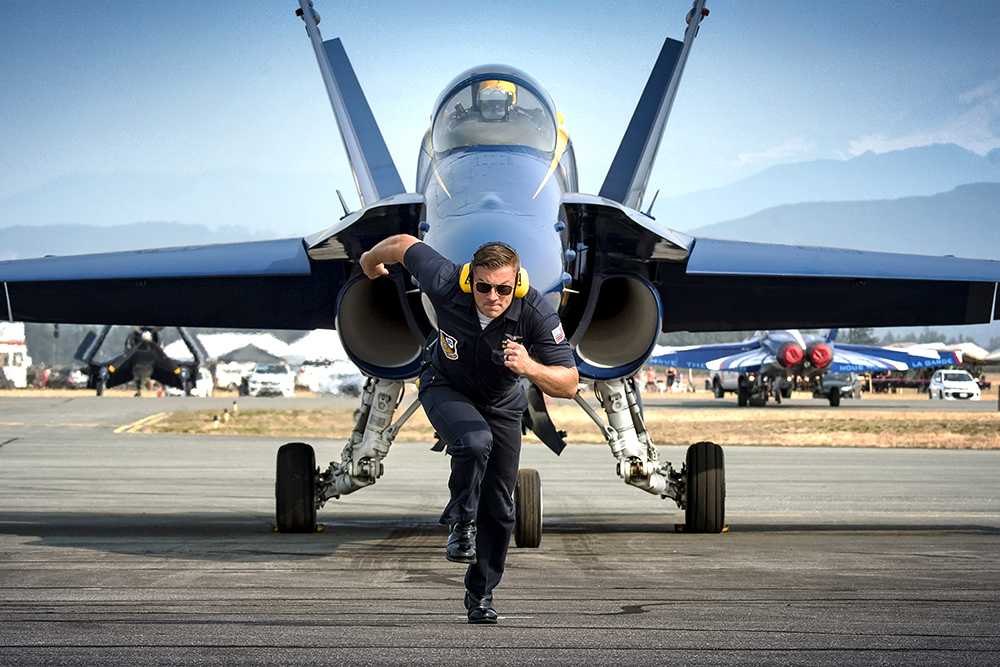
The US Navy Blue Angels returned to the Abbotsford International Airshow for the first time in 15 years in 2018. The event drew more than 110,000 people – the event’s largest crowd since the turn of the millennium.

2020s

In 2020, the Abbotsford Airshow missed only its second ever year since its inception due to the global COVID-19 pandemic. During the pandemic, the Airshow Society produced a ‘Virtual Airshow’; a two-hour video presentation featuring historical performances from the show plus exclusive cockpit footage and static display aircraft tours. The event was watched online by nearly 25,000 viewers. The pandemic also saw the launch of virtual S.T.E.M. programs for youth, teaching the fundamentals of aerospace through science, technology, engineering & math. It would be the start of a new strategic focus for the Airshow Society.

The Airshow returned in 2021 as a “drive-in” event to comply with health restrictions, staging performers out of 5 different airports in Canada and the United States.

In 2022, the Airshow returned to its traditional format featuring the Canadian Forces Snowbirds and US Air Force Thunderbirds to an overwhelming crowd of more than 100,000. 2022 also saw the debut of an innovative new LED Drone light show as part of the Friday Twilight performance, as well as a cooperative RCAF-USAF NORAD demonstration featuring the CF-18 Hornet and F-15 Eagle. A new S.T.E.M. Zone was introduced to the event, featuring interactive exhibits. The Airshow Society also hosted its first-ever youth S.T.E.M. camps over spring and summer break.


In 2023, the full USAF F-35 Demo Team performed in Abbotsford for the first time alongside the Snowbirds, CF-18 Hornet and US Navy Growler Demo teams. The Airshow Society continued to grow its youth S.T.E.M. programs over spring and summer breaks, and introduced a dedicated ‘Women in Aviation’ workshop as part of the Airshow weekend.

In 2024, the Abbotsford International Airshow was named an official RCAF100 event, helping to commemorate the centennial anniversary of the Royal Canadian Air Force. The event featured higher than normal participation from the RCAF, including the Snowbirds, CF-18 Hornet and Skyhawks Demo Teams, a 4-ship RCAF Heritage Flight with the CF-18 Hornet, T-33 Silver Star, P-51 Mustang and P-38 Kittyhawk. The event also saw the debut of the new RCAF CC-330 Husky on static display. The United States also commemorated the anniversary with the USAF F-22 Demo Team and F-16 Viper NORAD demonstration, as well as the US Navy P-8 Poseidon on static display.

In 2025, the Airshow would sell out for the fourth-consecutive year following the pandemic. The flying program was one of the most diverse ever, featuring not only significant participation from the RCAF, US Air Force and US Navy, but also the debut of all-electric flight demonstrations by the Harbour Air eBeaver and Pivotal eVTOL personal aircraft. These unique displays highlighted the Airshow Society’s mission to showcase all aspects of innovation and technology in aviation .

The event’s S.T.E.M. Zone also reached its largest-ever size in 2025, spanning nearly 3-acres of the site. The area included virtual reality experiences, flight and air traffic control simulators, a drone flying cage, interactive lego, electronic soldering and air rocket stations, and much more. Following the event, the Airshow Society formalized the acquisition of its local S.T.E.M. education partner Gearbots to create an in-house S.T.E.M. program.